When Graydon and I were chatting a few weeks back, we realized it had been over a year since our last conversation was published in Mindful Beauty Magazine. In between that article and now, we’ve had so many enlightening discussions about self care, age positivity, redefining your self worth, and how to heal holistically—not just your skin, but your whole being.
It only made sense to sit down again—recording ourselves this time!—to capture more of Graydon’s personal skin journey, alongside some of her thoughts, as a founder in the beauty space, on building a healthy, nurturing relationship with our own bodies.
Your background as a chef and yoga instructor has informed a lot of what you do now as a skincare founder, but I’m wondering if we can go back even further. When was the first time you really paid attention to your skin and the changes it was going through?
It was definitely when I was a teen. It was around Grade 13—a grade that doesn’t even exist in Canada anymore!—that I started experiencing some rosacea. Even before this, I remember my mother smothering me in cortisol cream and having to go to a doctor once a week for allergy shots. I hated the massive needle, but if I didn’t go my eyes would swell up and I’d have a hard time breathing.
All this to say, my body was very reactive and sensitive to things. And as a teenage girl—and frankly, even into my adult life—I struggled with my confidence because of these flare ups. I treated my skin like it was something I needed to wrangle or fight to control, doing whatever I could to “tame the beast.”
You might be able to tell just from some of the words I’m using that I didn’t have a very healthy relationship with my skin and my body. I thought of my body as a separate entity to “deal with” rather than an intrinsic part of myself that is worthy of love and self care.
Instead of taking this reactive, putting-out-the-fire perspective on my skin and my health, I needed to be in conversation with my body and my skin.
What I didn’t know then was that instead of taking this reactive, putting-out-the-fire perspective on my skin and my health, I needed to be in conversation with my body and my skin. I had to start paying attention to what my skin needed, and how my lifestyle, habits, diet, and skincare practices affected my overall wellness.
When did that mental shift start to happen?
It took a while, I won’t lie. There was a lot of judgement and beauty standards I had to unlearn—and even now this is something I’m still actively working on as part of my personal journey.
In the early days of trying to navigate my rosacea in the 80s, I went to a dermatologist’s office and I still remember the woman there, Dorothy. She had a big personality, tons of energy, and the classic large 80s blowout.
She was looking at my skin and said to me, “Dear, you need to be concerned about what’s going on with your face.”
I can still picture the moment all these years later. It wasn’t a dramatically rude or negative statement from her, especially as someone who was supposed to help with my skin, but it reinforced the ideas I’d already been internalizing from the world around me about beauty. That my face, my beauty, was something I needed to be constantly concerned with.
I grew up in a family that prioritized one's appearance, and as someone born in the 60s, there was still a lot of change that needed to occur at that time in history with respect to the perception of what women were good for—for example, the pervasive notion that girls should prioritize getting their Mrs.
There was also an unhealthy emphasis not to be too big or too thin—and as early as a preteen I was cautioned not to look too pretty (God forbid I used Bonne Bell lip smackers that I hid in my locker instead of chapstick). There was always the pressure of not looking cheap or sexual, or, on the flip side, too plain or tomboyish.
Because of this, I ended up putting a lot of my self worth into how I looked. So when allergies and rosacea started affecting my skin, it hit me especially hard. I didn’t feel capable or confident.
My inner reaction to Dorothy’s words was: “If my only attribute is my appearance, this means I’m in trouble.”
To pile on, the pressures of the time of needing to look pretty but not like you were trying too hard, and the shame being placed on women’s bodies was difficult. I remember getting in trouble for reading Are You There God? It’s Me, Margaret. The message I was given as a teen was that any girl who was sexual was bad, and it didn’t leave me with the healthiest relationship with my body.
That mentality stuck with me for many, many years and unpacking the negative thoughts I had about myself, my body, and my appearance was something that took a lot of time and energy. One of the first steps towards shifting that was when I went into women’s studies—it offered me a space to learn and empower myself. Then later, pursuing my love of cooking and working as a pastry chef ignited my creativity and passion; I proved to myself I was more than my appearance.
But it was getting into the yoga and wellness movement in the 90s that allowed me to reconnect with and come home to my body. Mentally, I was working on my confidence, but the disconnect to my body was still there. It was only discovering the power of intentional movement and breathing that reawakened the connection I had with my own body—I was able to fully inhabit myself for the first time in years.
Being able to repair that mind-body connection was deeply emotional and empowering.
What life lessons do you carry with you because of that journey?
Going to California, getting involved in the wellness movement, doing some yoga, learning some culinary skills, and then learning more about things like macrobiotic eating—these were the tools I equipped myself with to change the critical thoughts and beliefs I held about myself. I started thinking to myself: “I feel okay in my body. I’m not looking at myself with a self-loathing expression. I haven't had a flare-up in a while. Maybe I’m not so terrible—I have people around me who want to spend time with me.”
This knowledge sparked two life lessons or, I guess, inner understandings I carry with myself.
The first is that you need to equip yourself with tools that will bring you home to your body and give you a framework to build healthier habits for yourself. For me, that came through my passion for yoga and cooking. It will probably be different for you, but they are out there for you to discover at any age or stage in your life. When you’re stressed and you lack a routine, there’s wellness tools and rituals that aren’t complicated, expensive, or pseudoscience-y that you can use to give yourself a positive, affirming experience. You can use these tools to regain a sense of control over your life.
Your body, mind, and emotions are all interconnected.
The second is that your body, mind, and emotions are all interconnected. You have to heal yourself and work on yourself holistically. You can see this reflected in the chain of inner thoughts I had after moving to California. I had a better sense of self worth, my negative emotions were quelled, and my skin was healing. Those three things didn’t happen in separate vacuums—they were all interconnected to the work I was doing on myself.
And from an actionable standpoint, I’m sure people would be curious to know some of the specific habits and tricks you have to take care of your skin holistically.
The key is to follow a regular routine. Every habit or practice that you find works for your health and your skin is really only going to return long-term results if you stay consistent with it. For me, having a regular sleep schedule, eating as well as I can, incorporating movement into my day, and using gentle products (particularly ones that are soothing and anti-inflammatory) on my skin morning and night make a huge difference.
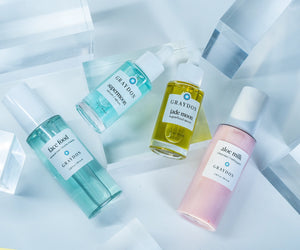
Some days I’ll still wake up with severely blotchy skin, but I know how to navigate my rosacea now. A thick layer of Putty and spritzes of Face Food throughout the day work for me. On really bad days, I have a stash of frozen Face Food ice cubes in my fridge that I rub on my face when it’s really inflamed.
Mentally and emotionally, I also like to check in with myself—is something going on in my life that is making me stressed or making it more difficult for me to stick to my routine? How’s my emotional health? I want to reaffirm that I’m not letting any flare-ups negatively impact the way I think about myself.
How has this journey of self-love and acceptance shaped Graydon Skincare as a brand?
The subtleties of how the world thinks we should look, what we should prioritize, and even how we should live our lives is woven into every part of our culture. It’s a quilt that can suffocate us sometimes with the weight of all those unspoken expectations.
We need to shift the way we talk about subjects like beauty, aging, and self care. Positively reshaping the relationships we have with our skin and our bodies matters.
Positively reshaping the relationships we have with our skin and our bodies matters.
I’ve seen too many beauty and skincare brands—especially the legacy brands that have been pushing anti-aging narratives for decades—create and foster insecurities about the way we look just to turn around and advertise a “quick fix” or “miracle solution” to us.
That’s why, for example, we don't use the term “anti-aging” at Graydon Skincare. We also take care, with every piece of information we share about our products or our brand, to center age-positivity and self-love over insinuating that the natural changes your skin goes through are “problems” that need to be “fixed.”
Instead, on top of creating products that are clean, gentle, effective, and sustainable, I want to inspire people to feel good in their skin—that’s where one of my favourite slogans of ours comes from: beauty is a feeling.
Any last pieces of wisdom you’d like to share?
Sometimes, we sabotage ourselves. We exclude ourselves and create self-fulfilling prophecies because we lack confidence or don’t believe we deserve to be our greatest selves. But there isn’t anyone—not even ourselves—who should be telling us that we’re bad or wrong, that we don’t fit the right mold.
We need to change the way we talk to ourselves. When we do that, we also pass this positivity down to the next generation, to our sons and daughters who deserve to feel confident and capable in their skin. That’s a legacy worth leaving behind.